Enhancing user experience at the frontier of AI
AI is radically changing how we design and deliver user experience (UX). Rapid prototyping and faster feedback are helping teams deliver better quality solutions while smoothing the lines between design and engineering. Here's how...
AI is revolutionising software delivery. From how we specify user needs to how we write code, no part of the development process has been left untouched. Its impact is real, but in reality, most teams are still finding their feet with the technology.
At Instil, our road to adoption has been a familiar one – driving safe and responsible adoption across the organisation in the face of an ever-evolving landscape. That change is unyielding, but several years into the journey, new and improved working practices have started to emerge.
I recently caught up with Dan Hurley, our Head of Design, to discuss how AI is changing our design practices and how, in turn, this is impacting our customers’ experiences for the better. Our conversation fell into four parts:
- The world that was - how we used to work
- Blurred lines - how we’re working today with AI
- Life at the frontier - where we’re experimenting
- Same as it ever was - what hasn’t changed
The world that was - how we used to work
First, a step back in time. As important as user experience is today, it is only relatively recently that the software industry started taking it seriously. User interface design was typically a one-and-done phase at the start of the development process. If you were lucky, you might have been shown a few concepts in Photoshop, but that was about it.
Experience only became relevant once we started putting users’ needs first - when we began asking for and valuing their feedback. And, as its importance increased, design slowly moved to the heart of engineering. Today, we view design as much an engineering discipline as creating code.
Like engineering, design has always been a process of experimentation, iteration and learning — exploring concepts with stakeholders, eliciting feedback, and evolving towards better solutions. The challenge for designers, however, has been less with design per se and more with feedback. The effort required to develop a single (reasonably high-fidelity) concept was so high that feedback loops were generally excessively slow.
To speed things up, designers conceived low-fidelity concepts in tools like Balsamiq or Figma. These served a purpose, but the delta between these concepts and the high-fidelity HTML reality meant that important signals were being lost in the noise. Ultimately, people will always find it easier to critique tangible software than a Figma interactive prototype or static screenshot.
As Dan puts it:
Until very recently, the design process was a slow, laborious loop of listening to users, translating concepts into a Figma prototype, and then asking users for feedback. That loop could take days or longer.
Given the reliance on design of so much downstream work, these delays could hit a project hard. Most of this effort is what I call ‘busy work’ - stuff that needs done but that gets in the way of engaging more actively with the customer.
It’s not where the value is. Not today.
Blurred lines - how we’re working today with AI
Skip forward to today, and the whole feedback cycle has been completely turned on its head. The effort to explore an idea has been dramatically cut from days to minutes. Designers can now reify whole workflows as software using a few carefully crafted prompts, enabling them to liaise and solicit immediate feedback from stakeholders.
'Busy work' has been replaced with more time for collaboration and critical thinking. Speed (which is often associated with a drop in quality) is actually enabling faster iteration, turbocharging the feedback process, leading to better decisions and improved outcomes.
The new tools? V0, Figma Make and Copilot. Initial concepts are still created in Figma, but designers then shift quickly into V0 to generate actual software for stakeholders to explore. For the first time, designers can now iterate and elicit feedback in situ with the people who matter – actual users.
Working directly in HTML also forces designers to consider design issues that may not have been apparent when working only in Figma. This blurring of the lines between design and front-end engineering means that when it comes to coding up the finished designs, there is less toing and froing between the design and engineering teams.
Here's how that process looks:
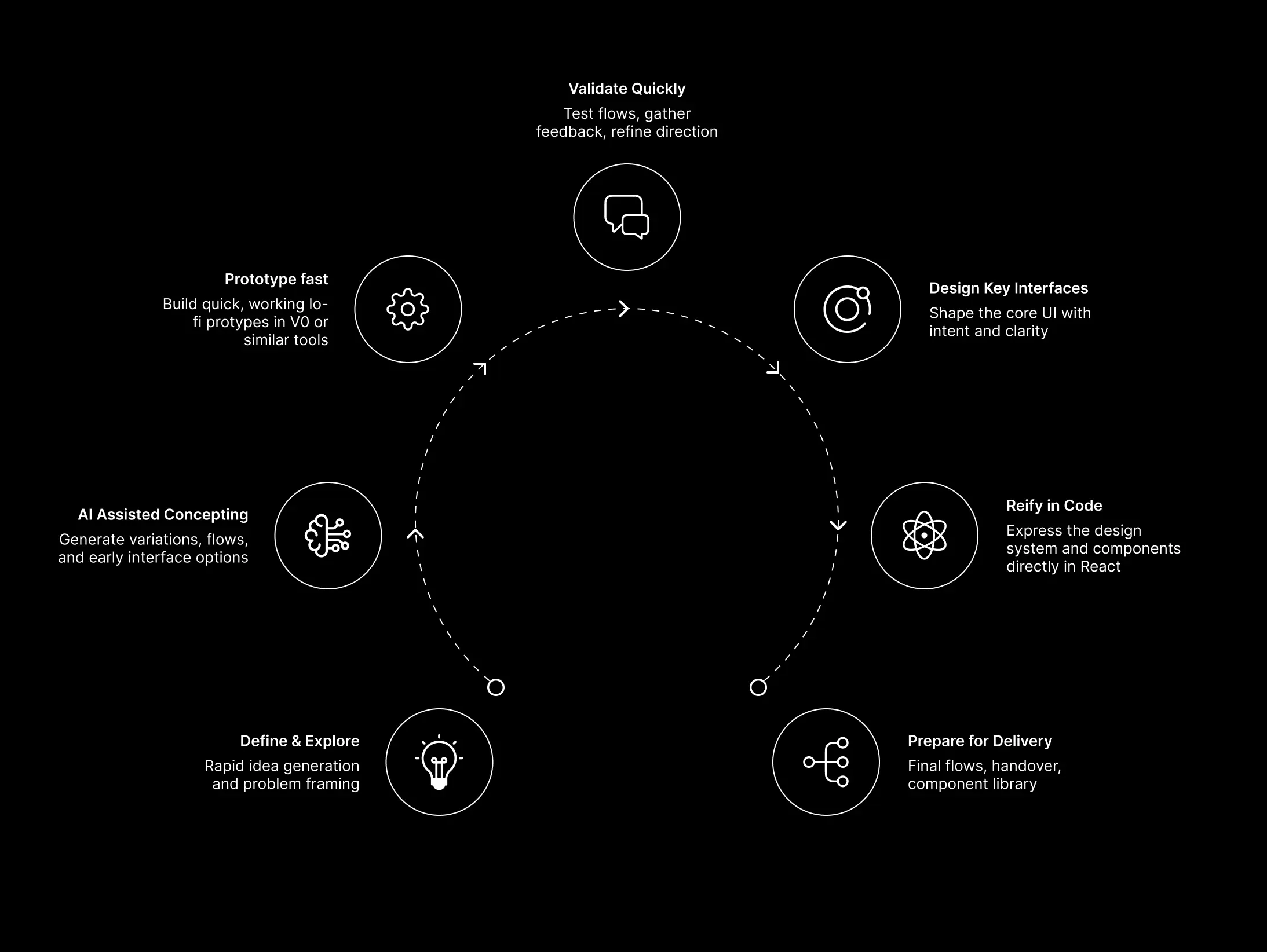
When precision matters, the teams still use Figma – it remains the source of truth, codified in a design system - but when we need to rapidly iterate through concepts, AI has become our new best friend. It is our playground of choice for developing ideas and workflows.
Back to Dan:
The power of AI is the speed of translation. We’re cutting out the friction between idea, interface and implementation. The grunt work is gone, so momentum stays high.
But it’s also changing our ability to explore and validate ideas quickly. In the past, we would be hard-pressed to try 2 ideas over a few days. Today, we can explore ten with minimal effort. That volume changes outcomes.
There is no doubt that the lines between design and engineering are starting to blur. The space between a drawing and a working artefact is basically gone, or at least on the way out. Figma is still an essential tool, but the fact that we can create plausible software in minutes has undeniable value for designers and our customers.
All of which begs the question, if anyone can assemble a UI, where’s the value in design? It’s a fair point – tools like V0 can generate extremely compelling user interfaces in no time - but the devil is in the detail. Once you drift into complex workflows or specialist interfaces, that detail matters (e.g. we do a lot of work in the audio industry).
As systems grow in complexity, the importance of managing coherence and consistency only grows and becomes more vital. There’s nothing more annoying for a user than subtle (or not-so-subtle) inconsistencies across screens. This is where humans play best – using our taste and know-how to design experiences relevant to the domain.
In this new world, existing skills and expertise are still vital. If anything, the designer skillset has only expanded, e.g. into the code. The big difference is that they now have more time to speak directly with users and to explore possibilities. This is a very good thing.
Life at the frontier - where we’re experimenting
Affecting change is hard at the best of times, but when there is so much fluidity and uncertainty about what is next, it’s almost impossible to keep up. Core to our internal drive to adopt AI has been finding the sweet spot between encouraging experimentation and challenging the status quo. We know that staying where we are was not an option.
Out of this has come a realisation that AI brings tremendous value in certain places, but that it’s also not a magic hammer for every problem. We’re now at a phase of institutionalising new practices into our ways of working, while continuing to experiment at the frontier.
As Dan says, we’re far from done:
We’re still learning how to blend generation with human judgement. In part, this is about how we develop our understanding of how to use the tools effectively – adjusting to their non-deterministic nature, playing to their strengths and weaknesses – while ensuring our relationship with the tools remains human-led.
I think the tools are moving faster than our workflows can keep up. But that’s okay, we’re already seeing huge value. Plus, best practices take time to emerge.
I’m particularly excited by targeted models (just look at the recent improvement to Google Gemini), adaptive interfaces (a cert in my opinion), and agents. For example, we are currently testing where agents help and where they get in the way. Ideally, they will act in predictable ways rather than just advise/ask questions constantly.
One thing to watch is the direction of travel with the top-end models. If Gemini is anything to go by, the next generation of models will be constructed from cleaner, better-curated datasets, which will lead to better predictions. It’s a quality game now, not just a size game.
But a note of caution. While it might seem that we are entering the fast-food era of design – off-the-shelf Michelin star food at value meal prices – the reality is, delivering great user experiences is like serving great food! It still takes time. Yes, parts of the design process have undoubtedly been sped up, but these savings have been offset by more feedback and deeper research into possibilities.
Same as it ever was - what hasn’t changed
With so much happening in the AI space right now, some might have us believe that design (and software engineering in general) is destined to become a purely “AI-generative” activity - that we will become curators of content generated by models, fed with judicious prompts.
But while these incredible tools can take care of so much of the heavy lifting, it is imperative that teams understand their limitations and lean into where humans will continue to add real value.
Fundamentally, user experience has not changed, even if the tools to create those experiences have. Clarity, understanding users, system thinking - all of these still matter. And of course, taste – machines have none. They simply regurgitate captured patterns and facsimiles of other people’s work.
These patterns might form the basis of how we design, but they still need to be applied in creative ways that solve real problems. The foundations still matter, no matter how clever the hive mind becomes. But design is not just in the detail - it’s about the big picture and overall context.
- The future of design will continue to be thought-led and AI-assisted. AI helps with thinking, learning and bringing clarity upfront, but it must not become a replacement for our brains. I know from experience, using the tools is very much about being the shepherd - corralling the outputs into something that accelerates the subsequent engineering activities.
- Dial up or down our use of AI relative to the context. When teams need to iterate quickly, when the fidelity of output does not matter (e.g. proof of concepts), then we should only be using AI. But when tasks require thought, nuance and precision, this is where we should take over, with AI-assistance of course.
- The last 20% is still the hardest yards. The minimal effort it now takes to get to 80% ‘done’ can lead to lots of manual rework later to enable the last 20%. Getting to 80% is seductive - it comes quickly, feels good and has an illusion of being 'almost done' - but that last mile is where the real work starts and where the shortcuts become exposed.
Final thoughts
AI is undoubtedly changing the face of the design process. It is enabling more rapid iteration, more experimentation and better outcomes for customers. Design will not be replaced by AI, but it is undoubtedly being changed for the better by it.
After some initial scepticism and not a little fear (will AI eventually disintermediate design?), our teams have come to realise that the future of design is AI-assisted. But as important as the tools have become, design continues to be a fundamentally human-led activity, one that requires empathy and understanding of how users interact with software.
The need for skilled practitioners, system thinkers and creativity is greater than ever.